
In August 2023, Hun Sen, who had ruled Cambodia with an iron fist for 38 years, passed the prime minister's seat to his son, Hun Manet. Attention focused on how Cambodia, led by Hun Manet, a graduate of a prestigious British university with a degree in economics, would change. Hun Manet's education, including a PhD in economics from the University of Bristol, after graduating from the US Military Academy and earning a master's degree in economics from New York University, led to expectations that Cambodia might adopt a pro-Western policy.
China-backed Khmer Nationalism
Hun Manet's first choice in governing was economic revival through China. In September 2023, shortly after Hun Manet became prime minister, Cambodia signed a $1.7 billion contract with China Road and Bridge Corporation (CRBC) for the construction of the Funan Techo Canal. This massive project will connect the canal from Phnom Penh, Cambodia's capital, to the Gulf of Thailand, and includes three dams, eleven bridges, and 208 kilometers of walkways. The canal, with a width of 100 meters and a depth of 5.4 meters, can accommodate up to 3,000-ton cargo ships during dry seasons and up to 5,000-ton ships during the rainy season when the river levels rise. The Funan Techo Canal, slated for completion in 2028, is majority-owned by the Cambodian government (51%), but the entire $1.7 billion investment comes from Chinese funds. China Road and Bridge Corporation will construct and operate the canal for 40-50 years before returning it to the Cambodian government.
According to the Cambodian newspaper Khmer Times, which reported on the groundbreaking ceremony for the Funan Techo Canal on August 5, 2024, Prime Minister Hun Manet called the project "a historic undertaking" and said "it must be completed no matter what." Cambodia, lacking adequate port and road infrastructure, relies on Vietnam's Ho Chi Minh City port for 33% of its import and export volume. The project is a crucial endeavor for Cambodia to gain control over its logistics. While Cambodia benefits from various free trade agreements (FTAs) with Vietnam, which provide some tax advantages, Cambodia's reliance on its neighbor for development hinders its progress. Therefore, Prime Minister Hun Manet stated that the Funan Techo Canal project is "allowing us to breathe on our own." The Cambodian government projects that the canal will create 5 million jobs and significantly reduce transportation costs by bypassing Vietnam. Initial annual revenue is projected at $88 million, increasing to $570 million by 2050.
However, many believe these projections are overly optimistic. The Lowy Institute, an Australian think tank, criticized the Cambodian government's projections as unrealistic, based on an annual growth rate of 8.1%. Mongabay, an American environmental science publication, also expressed concern about the profitability of the project, noting that "typical Chinese Belt and Road funding carries interest rates of 5-10%." The experiences of Sri Lanka and Laos, which faced severe debt crises after undertaking infrastructure projects funded by the Chinese Belt and Road Initiative, serve as cautionary tales for Cambodia.
Funan Techo Canal Targeting Vietnam
Vietnam is closely monitoring Cambodia's canal project. The canal's construction could have devastating consequences for the environment of Vietnam's southern Mekong Delta region. The Mekong River flows from China through Myanmar, Thailand, Laos, Cambodia, and Vietnam. Construction of the canal in the upstream country, Cambodia, could alter water flow and river inflow, impacting Vietnam. In May 2024, the US think tank, the Stimson Center, warned that the canal's construction could lead to water shortages during dry seasons and floods during rainy seasons in Vietnam. The Mekong Delta region of Vietnam is a vital food basket, responsible for 95% of Vietnam's rice exports, 70% of fruit production, and 60% of seafood. However, the region is facing water shortages due to climate change, upstream dams in China and Laos, and other factors. In April, a severe heatwave led to saltwater intrusion into drinking water sources, creating a crisis. Vietnam has consistently urged Cambodia through diplomatic channels to conduct joint environmental impact assessments for the canal project. However, the Cambodian government insists that the canal's impact will be minimal and that the project will proceed as planned.
Relying on Chinese Military Power for Khmer Revival
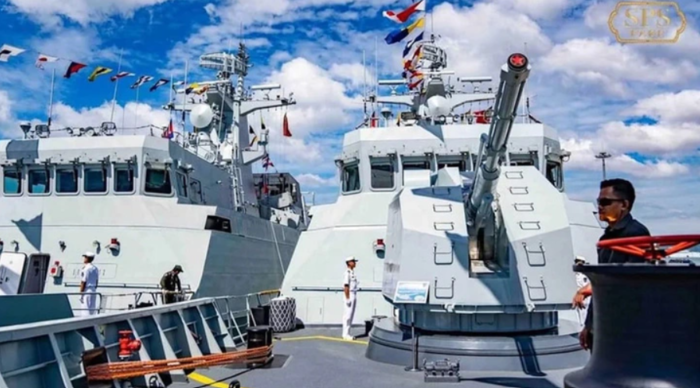
The construction of the Cambodian canal is also a sensitive military issue. Vietnam is concerned about the name "Funan Techo" canal. "Funan" was the name of the ancient Cambodian empire that controlled territories in present-day Thailand and southern Vietnam from the 1st to 6th centuries. "Techo" in Khmer means "powerful." Therefore, the Funan Techo Canal project can be interpreted as Cambodia's declaration of reviving the Khmer nation, leveraging Chinese power to break free from Vietnam's influence. The canal, stretching 180 kilometers from Phnom Penh to the coast, is directly connected to the Cambodian Ream naval base, which is effectively China's second overseas naval base. While the Cambodian government denies the presence of a foreign military base, citing its constitution, few believe this claim. Two 1,300-ton Chinese People's Liberation Army patrol ships have remained docked at the Ream base since December 2023, without returning to China. These warships are equipped with anti-ship missiles, rapid-fire cannons, helicopter landing pads, and stealth technology. If the Funan Techo Canal is completed, these warships could reach Phnom Penh in a matter of hours, potentially enabling Chinese intervention in any conflict between Cambodia and Vietnam.