The US business magazine 'CEOWORLD Magazine' released a ranking of countries with the most debt to China in 2024, based on World Bank data on May 6. Most of the top 20 countries were poor countries in Africa and Asia. Laos, a country of global concern, has debt equivalent to its GDP (Gross Domestic Product) of $10.5 billion (approximately $14 trillion), half of which is owed to China.
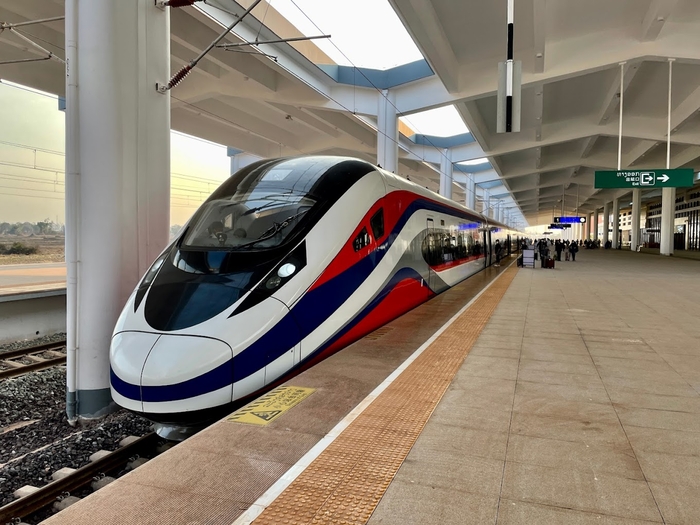
Laos has actively participated in China's 'Belt and Road Initiative' since 2015. Key projects include hydropower projects in the Mekong River basin and highways connecting to the Chinese border. In particular, the 414 km high-speed rail between China and Laos, opened in December 2021, is recorded as a project that established an important logistics network for Laos. In addition, on July 19, a railway line was opened from Laos to Bangkok, Thailand, connecting China-Laos-Thailand-Malaysia by rail. For the landlocked country of Laos, this was a project to secure a logistics network connecting to the coast of China and Malaysia. However, Laos, with almost no manufacturing infrastructure, can only export agricultural products and some natural resources to China. Conversely, various cheap Chinese manufactured goods and agricultural products are dominating Laos, leading to a deepening economic dependence on China.
Laos Dependent on the Chinese Economy
According to a study by the AidData research institute at the US William & Mary University, which tracked China's overseas loans and grants, $5.9 billion (approximately 7.9 trillion won) was invested in the China-Laos high-speed rail project. The railway project was jointly invested in by China and Laos, with a 7:3 share split. Laos secured most of the funding needed through loans from the China Exim Bank. Laos' national debt doubled as a result of participating in China's Belt and Road Initiative. $55 billion was invested in hydropower projects on the Mekong River, $38 billion in the construction of a 176.3 km road connecting northern China and Laos, and $12 billion in economic zones and industrial parks. Generally, the projects are built with Chinese capital and operated by Chinese state-owned enterprises, to be returned to Laos after 50 years. The problem is that while the intention was to borrow Chinese capital to expand national infrastructure and generate national benefits, Laos is failing to repay the interest properly. According to the World Bank, Laos' deferred debt payments to China amounted to $20 billion (2.7 trillion won) between 2020 and 2023.
As national debt increased and foreign exchange reserves decreased due to excessive participation in the Belt and Road Initiative, the Lao kip (the Lao currency) plummeted against the US dollar. According to the 'Laos Country Overview' posted on the World Bank website in April 2024, "The Lao kip fell by 23% against the US dollar between January 2023 and February 2024, contributing to high inflation of 25% in February 2024." As of September 1, 2024, the exchange rate of 1 US dollar to 11,200 Lao kip on January 1, 2022, has risen to 22,170 Lao kip, a nearly 100% increase in 2 years and 8 months. As the exchange rate soared, the debt payable in Lao kip increased astronomically, trapping Laos in a debt crisis. If Laos fails to repay its debt, hydropower dams, highways, and railways jointly invested in with China will become China's property. Laos already transferred 90% of the shares of the Lao state-owned power transmission company (EDLT) to China Southern Power Grid in September 2020. This was done to partially cover the $55 billion debt incurred from 23 hydropower projects that Laos could not afford. Now, if China decides not to supply power, the entire Lao nation will come to a standstill. Laos is now completely dependent on China.
![[ASEAN, Near and Far] (37) Laos Trapped in China's Debt Trap](/data_column/weekly.khan.co.kr-2-37/data_2.jpg)
China's Debt Trap Diplomacy
Brahma Chellaney, a professor at the Indian New Delhi Policy Research Center, has termed this 'China's debt trap diplomacy'. China offers funding and infrastructure projects to developing countries, ostensibly for joint development, but these projects often fail to generate profits, leading to astronomical increases in the countries' debt. Countries with no way to repay their debt eventually end up transferring ownership of infrastructure projects to China. This has happened frequently with projects like Pakistan's Gwadar Port, Sri Lanka's Hambantota Port, and Uganda's Entebbe Airport, which participated in China's Belt and Road Initiative but ended up with only debt and loss of national infrastructure. Another concern is that China's proposed infrastructure projects are often not beneficial to the host countries, but are instead proposed due to China's military and security needs. The Gwadar Port in Pakistan and the Hambantota Port in Sri Lanka are highly suspected to have been projects to establish Chinese overseas naval bases in case of a US blockade of China.
Countries trapped in China's debt trap also become politically dependent on China. Cambodia, the second-most indebted country in ASEAN to China after Laos, sided with China during its ASEAN chairmanship in 2012, preventing the adoption of a joint statement on the South China Sea issue. This was the first time a joint statement was not adopted in ASEAN history. In 2016, Laos, which was the ASEAN chair, also prevented the inclusion of the International Tribunal for the Law of the Sea's ruling on China's South China Sea claims in the ASEAN joint statement, proposed by Vietnam and the Philippines.